
This past week, Caltrans hosted two “Understanding Bicycle Transportation” seminars that were attended by bike activists representing illuminateLA, the Bike Writers Collective, Sustainable Streets, the LA Bike Working Group, Bikeside, the OCBC, and CICLE, by municipal planners representing Pasadena, Long Beach, Claremont and San Dimas, and by Caltrans staff including Engineers, Planners, Architects, Environmental and Legal.
Missing from the meeting was staff from the LADOT Bikeways Department. While some participants travelled from distant cities by plane, train, and automobile, staying overnight in hotels, the LADOT staff would simply have to walk downstairs from their 9th floor office in the same building. But they didn’t.
This is especially unfortunate because the subject of Sharrows was addressed during the seminar and the LADOT Bikeways staff missed hearing the “Understanding Bicycle Transportation” instructors address these points:
1) Sharrows should be positioned in relation to the travel lane to the left, not the curb line to the right.
2) Sharrows should be positioned (default placement) between the tire tracks of motor vehicle traffic in order to indicate a lane control position and to increase life of the Sharrows.
3) Sharrows must be placed so that they both discourage too-close-in-lane passing by motorists and door-zone (<13’ from the curb) riding by cyclists.
During another portion of the seminar, an instructor addressed poorly positioned Sharrows and liability and responsibility:

1) If a motor vehicle traveling in a straight line in the travel lane and a cyclist riding a meandering line of Sharrows placed a consistent distance from the curbline of a variable width street were to collide, the motorist would have right-of-way. Aftert all, the cyclist would be "merging traffic" and would be at fault.
2) Sharrows should be placed so that the cyclist using the Sharrows as a guide for lane position ends up in control of the lane, not in an inferior right-of-way (ROW) position that engineers conflict.
Meanwhile, back on the streets of Los Angeles, there are three issues with LA’s pilot Sharrows project that need to be addressed by the LADOT’s Bikeways Department. Requests for clarification and adjustment have elicited evasive responses that do not resolve the simple engineering dilemma.
1) The purpose of a Sharrow as articulated by the CTCDC and Caltrans is threefold:
a) To position cyclists out of the door zone. (minimum is 11’, experts call for 13’)
b) To position cyclists in a lane control position on a non-sharable (<14”) lane.
c) To clearly communicate to road users the correct lane control position for cyclists.
2) LA’s pilot Sharrows project adheres to two arbitrary installation guidelines:
a) The Sharrows are consistently placed 12’ from the curbline, even on a street of variable width.
b) The Sharrows are inconsistently placed at variable distance from each intersection, not based on the distance from the intersection but placed adjacent to the first vehicle parking space.
3) LADOT’s Bikeways Department either has guidelines and a standard for its pilot Sharrows project or it doesn’t.
a) If it does, they need to be public and they should be in the hands of LA’s Bicycle Advisory Committee. They also should be in the hands of the public which purportedly will offer feedback on the Sharrows and in the hands of the Neighborhood Councils which monitor the delivery of city services. This is especially true for the East Hollywood Neighborhood Council which actually contributed their money to help fund the Sharrows program.
b) If it doesn’t, they need to look to Long Beach and borrow theirs. They need to look to Hermosa Beach and borrow theirs. They need to look to Oakland and borrow theirs.
The City of Los Angeles is surrounded by cities who take a short amount of time, prepare a plan, involve the public, and then proceed to do good work, setting standards for excellence and picking up awards and further funding as they go.
Why doesn’t the LADOT Bikeways Department simply imitate success.
The current debate over the elements of LA’s pilot Sharrows projects consists of some simple questions and objections from the public and non-responsive evasive distractions from the LADOT Bikeways staff:
1) LADOT says that this is a pilot project and that these issues are being addressed for the first time. Simply not true. As one angry LABAC member recently pointed out “In 1997 I drove up to Oregon where I saw Sharrows for the first time. I took a picture of them and presented it to the LADOT back in 1997 at a BAC meeting. The LADOT came back and said the concept of a Sharrow was a dangerous liability to the City and they wouldn't consider it.”
The subject of Sharrows is not new, the science of engineering the Sharrows isn’t new, the California Traffic Control Devices Committee, Chaired by the LADOT’s John Fisher, approved Sharrows on August 12, 2004. To hide behind the “We’re new at this!” is simply an avoidance of responsibility by the LADOT Bikeways Department.
2) LADOT responds that calls for supporting signage are new and isolated. Again, simply not true. When the Santa Monica Boulevard Transit Parkway was being built, the subject of “engineered conflict” came up (2005) and the public requested “Yield to Bikes” (R4-4) signage support but the request was denied.


3) LADOT responds to calls for positioning the Sharrows based on a relationship to the lane marker to the left as new and isolated. Again, simply not true. The MUTCD’s Guidance on bike lanes directs:
Bicycle Lane Markings on Class II Bikeways (Bike Lane) – page 9C-3
Guidance:
Bicycle lane markings on Class II Bikeways (Bike Lane) should be placed a constant distance from the outside motor vehicle lane.
In 2006 this was an issue on Sunset Blvd. where the bike lanes were positioned an equal distance from the curbline, not from the travel lane. The significant variable width of the street resulted in bike lanes that had a meandering relationship to the adjacent travel lane.
4) LADOT responds to comparisons to other cities by feigning ignorance and challenging critics “What cities?” as if they don’t know. If it’s true, it demonstrates a failure of relevance. If it’s not true, it is absolutely unacceptable.
Look at the center lane positon supported by the green stripe on the Sharrows in Long Beach. Look to the R4-11 signage support on the Sharros in Hermosa Beach. Look to the Oaklands standard for guidance on how to plan, how to communicate, how to disseminate information so the public, the implementation team, those responsible for evaluating, those responsible for oversight are all in sync.
LADOT’s Bikeways Department fails to acknowledge the three mandates for Sharrows, instead adhering to two arbitrary rules (12’ from the curb, only alongside parking)
The three biggest problems with the LADOT’s placement of the Sharrows:
1) Strict adherence to the “12’ from the curb” position results in Sharrows that sometimes direct cyclists to an incorrect position.
a) Fountain westbound past Vermont, the Sharrow puts the cyclist in a right turn lane, setting up a right hook conflict. Engineered Conflict!
b) 4th Street westbound approaching Vermont, the Sharrow puts the cyclist in a right turn lane to the right of a through/right turn combo lane. Engineered Conflict!
2) Strict adherence to the “12’ from the curb” position results in Sharrows that meanders while through traffic should follow a straight line.
a) Fountain has wb sections where the Sharrows direct cyclists to merge in and out of through traffic.
b) 4th Street has a Sharrow 10’ off the center followed by a Sharrow 15+’ off the center followed by a Sharrow 10’ off the center. This takes place with no sensitivity to the intersection treatment. (flared approach to facilitate right turns, merging traffic from intersection into one lane)
3) Strict adherence to the LADOT’s “Sharrows only adjacent to vehicle parking” policy results in a violation of the Caltrans guidance: “If used, the Shared Roadway Bicycle Marking should be placed immediately after an intersection and spaced at intervals of 75 m (250 ft) thereafter.”
a) Churches and Convalescent homes with loading zones and parking restrictions may not have on-street parking in front but that shouldn’t interfere with the placement of Sharrows “immediately after an intersection” but the LADOT places them at variable distances based on parking.
b) This results in variable positioning and a delayed merging action at the rear of the first parked car instead of a simple position clarification immediately after the intersection. Very non-sensitive to the context of the environment.
4) Strict adherence to the LADOT’s “Sharrows only adjacent to vehicle parking” policy also results in the placement of Sharrows too close to approaching intersections where traffic should be sorting based on destination (through vs. right-turn) but the Sharrows hold the cyclist in position too long. (Fountain approaching Western or 4th approaching Vermont)
5) The failure of the LADOT’s Bikeways Department to connect with the other city departments that have authority over elements of Fountain and 4th Street demonstrates a complete disconnect from the United States Department of Transportation Policy Statement on Bicycle and Pedestrian Accommodation Regulations and Recommendations which calls for “improving non-motorized facilities during maintenance projects.”
a) It is acutely apparent that the LADOT did not consult with the DWP nor was a survey of water main covers conducted in advance of the Sharrows installation.
b) It is acutely apparent that the LADOT’s partnership with the Bureau of Street Services on the Sharrows installation did not include any synchronicity of street resurfacing or maintenance or pothole repair.
c) It is acutely apparent that this was not a consideration because the LA City Department actually installing the Sharrows at the direction of the LADOT’s Bikeways Department is the same department responsible for LA’s street maintenance and repair.
It is imperative that the LADOT’s Bikeways Department immediately develop and implement a Sharrows Standard, even if only a temporary “pilot project” standard, and that it correctly position the Sharrows based on the travel lane (not the curb), that it correctly position the Sharrows in the lane control position on non-shareable lanes (<14’) and that it clearly communicate (signs and paint) to all road users the correct positon of cyclists on the street.


 All this on Hollywood Boulevard, the "Walk of Fame," a pedestrian oriented district and a transit hub, a community with such potential if only there were some bike racks upon which to rest a weary bike. Between La Brea Avenue and Western, there are approximately half a dozen inverted U bike racks, one of the simplest, cheapest and most effective forms of bike parking and yet so rare.
 The Metro Village (Red Line) development on the SE corner also has bike parking with two typically unused wave racks on the street level and the more popular and effective inverted U racks in the center behind a wall. There's also a bike locker for two but that's a VIP situation and the waiting list is a year long. The inverted U racks have a bike carcass still attached as a reminder to all that leaving a bike at the Hollywood & Western Red Line station is at your own risk. With empty storefronts and a patio that now serves as a campground, the station is far from a secure location for bike parking. Too bad. Such promise if only the racks were in a better position.


 Sometimes they take on a whimsical or artistic flair.
 They simply need to run parallel to foot traffic and offer two points of contact for the frame.
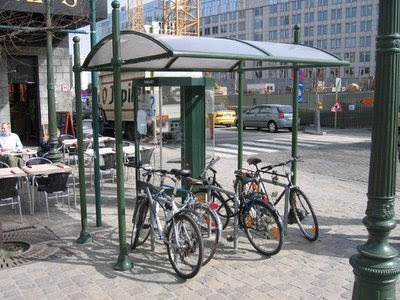 In some lands they even protect from the elements. (I know, we don't even do that for people!)
 Car spaces can be converted into bike parking with great success and look at the capacity !
 Great racks in great locations are good for cyclists and good for the neighborhood and good for business!
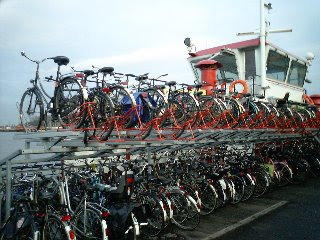 Bike parking can also be innovative and opportunistic, such as this out of commission boat that uses the sliding racks like the ones that have been sitting unused at Hollywood & Western for a couple of years.
 These are some of the loneliest bike racks in the city of Los Angeles. The next closest racks are a mile to the west and a quarter mile to the east.
  When in doubt, add some more racks.
 Why can't we get along?
 Apparently we can!
 For the nature lover in all of us!
 While cities such as Chicago fumble along with commitments and results, Los Angeles demonstrates its unique approach to supporting the cycling community by putting pen to paper towel and drafting some almost accurate plans for bike parking installation, closing any back doors and putting to rest any insinuations that the LADOT is insincere in its support of cycling as a valid means of transportation.


 Posts
Posts


