Friday, March 27, 2009

CityWatchLA - Officers Defy Order from Council, Board and Chief

CityWatch, Mar 27, 2009
Vol 7 Issue 25

Failure to Communicate?
By Stephen Box

Cyclists on a Saturday night bike ride through mid-city Los Angeles incurred the wrath of the LAPD and ended up detained, handcuffed and cited for infractions that included riding a bicycle without a bike license and carrying a driver’s license with an out of date address.

According to LAPD Information Officer Anna Aguirre, the incident began when they received a call of "assault with a deadly weapon" at 3rd and La Brea. Officers responding to the call encountered approximately 100 cyclists in the Ralphs parking lot and called for "all available units." The deadly weapon turned out to be a motor vehicle and the victim turned out to be a cyclist. LAPD officers interviewed the motorist and the cyclist and determined that no crime had been committed and allowed the motorist to leave. At the same time, supporting LAPD officers and their supervisor began detaining arriving cyclists still in the street, handcuffing them and ultimately issuing the tickets that critics hold up as evidence of harassment.

In January the City Council declared a moratorium on the enforcement of LA's bike license law. This action followed a Police Commission recommendation a month earlier to immediately enact a moratorium in the enforcement of LA's bike license law, an action that followed a report from Police Chief Bratton recommending the repeal of the law because it was ineffective and outdated.

Bratton goes so far as to say "Given our continued efforts to deploy all available sworn personnel to field operations in direct support of our crime fighting and community policing efforts, reviving the bicycle licensing program at this time is not prudent."

None of which seemed to matter to the Officers who now had several cyclists in handcuffs and were busy cutting the backpack off the back of a cuffed detainee as he lay facedown across the trunk of a police car. A cyclist on the other side of the intersection secured his bike and began photographing the incident on foot from different vantage points. He then crossed the street, earning a pair of cuffs and a ticket for crossing "against a circular red," a violation typically reserved for motorists, not pedestrians.

The photographer, bike activist Alex Thompson, took his photos and his ticket to the Police Commission this past Tuesday and leveled a charge that the responding LAPD officers detained cyclists in handcuffs and then stretched their imaginations to come up with citable offenses, all without probable cause. The Commission immediately turned the case over to the Inspector General.

As of this past Wednesday, Captain Davis, Commanding Officer for the Wilshire Area, has released a statement that indicates in part " With regards to the citations for no Bike License, the "No License" section has been canceled. And, in the spirit of the law the entire citation for the two violators will be canceled. The policy for the moratorium on bike licenses has been discussed with my command. This is a lesson learned, your cooperation and understanding on this matter is appreciated."

Critics of the incident claim that canceling the tickets fails to answer some significant questions including 1) on a Saturday night in LA, is it really a priority to herd cyclists off the street? 2) how does a City Council, Police Commission and Police Chief directive calling for a moratorium on the bike license law get missed by so many LAPD officers and supervisors? 3) why are the responding officers working so hard to find infractions that they will handcuff a cyclist and spend 15-20 minutes looking up obscure and unenforceable code?

The LAPD's position, according to Watch Commander Sgt. Pickett and Information Officer Aguirre, is that the LAPD received reports of traffic violations, alcohol use and other violations by the cyclists on the street that night and that they were just responding to complaints. Cyclists countered this claim by challenging the LAPD to cite those who violate the law, not simply anyone riding a bike.

As for the charge that the handcuffing of the detainees was an extreme and unnecessary tactic, apparently it's the Officer's discretion to use handcuffs "to maintain safety and control." Unfortunately, no records are kept so there is no way of analyzing or evaluating the use of restraints by officers, by area, by incident or any other criteria.

As for the missed memo, a couple of questions: If an order from the City Council, Police Commission and the Police Chief can be missed/ignored by LAPD officers in the field what will it take to get their attention. And, maybe a reissue of Chief Bratton’s comment about devoting manpower to cuffing cyclists with the need to fight real crime is in order. You think? (Stephen Box in a transportation and cyclist advocate and writes for CityWatch. He can be reached at Stephen@thirdeyecreative.net)

Tuesday, March 10, 2009

CityWatchLA - Students Win 4-Way Stop for Hollywood School

CityWatch, Pub: Mar 10, 2009
Vol 7 Issue 20

Pulling a play from Saul Alinsky's "Rules for Radicals," the students in the Hollywood Schoolhouse's Leadership Class successfully used the threat of a student march down Fountain Avenue to Councilman LaBonge's office, at first getting his attention, then getting his support and finally getting a promise of a four-way stop sign at the intersection of Fountain and McCadden. Not only that, it came with the assurance from LADOT Assistant John Fisher that it would be installed within two weeks.

The best part is, the march never took place. At first rescheduled and then finally cancelled, the students instead held a Thursday afternoon rally on their playground and hosted parents and LaBonge. It's a good thing the kids never marched because the sidewalk from the school to the Hollywood Constituency Center is narrow, uneven and broken. Add the uncrossable streets and the intense traffic and the route was hardly suitable for a protest march.

Of course, that's the point. Fountain Avenue is hardly an appropriate route for pedestrians. Yet that's the route the kids take every day when they walk from the school to their educational garden several blocks away. All on 3rd world sidewalks, past the neighborhood liquor store and alongside the traffic that weekly sends a car careening onto the sidewalk, into a fence or across somebody's front yard.

Debbie Wehbe, President of the Central Hollywood Neighborhood Council, reports "the area is simply not safe for pedestrians, not just because the intersection is dangerous to cross but because the cars speed around each other, causing collisions that occur on a regular basis." Wehbe pointed out the scarred fence, the skid marks and the narrow sidewalks that bear witness to the vulnerability of the pedestrians who dare to walk alongside the heavy traffic. "The last accident had a motorist racing at 45 mph from one stop sign to the next stop. It's madness!"

Brent Becker, a parent who has been involved with the school for 9 years reports that there was some opposition to the 4 way stop signs but countered "It won't slow down traffic, it's already at capacity. It will simply make it safer for our kids to cross the street."

The Hollywood Schoolhouse has been in the neighborhood since 1945. It has grown, just like the neighborhood and it sits in one of the most densely populated areas of Los Angeles and it suffers from some of the most intense cut-through traffic in the city.

Stephen Bloodworth, Head of School, was proud of his students explaining "Our school has a long history of civic engagement and in the tradition of its founders, we offered the students in the Middle School Leadership Elective class the opportunity to select a project. They organized themselves around the public safety initiative and selected the intersection of Fountain and McCadden for the focus. They wrote the speeches you heard today, they made the signs you saw today and they wrote the letters that drew the attention of our Councilman, all of which culminated in this victory for everybody."

Bloodworth was beaming as he surveyed the his students and declared "This is a great civics lesson that furthers our mission and makes it safer for our kids to go to school."

As for the intersection improvements at Fountain and McCadden, LaBonge was careful to point out that the stop signs would not be supported by crosswalks, explaining "Our studies show that there are more injuries to pedestrians when there is a crosswalk than when there is no crosswalk. You see, crosswalks give pedestrians a false sense of security." (Stephen Box is a transportation activist and writes for CityWatch. He can be reached at Stephen@ThirdEyeCreative.net)

Friday, March 06, 2009

CityWatchLA - The Little Campaign that Could

How NO on Measure B Prevailed
By Stephen Box

CityWatch, Mar 6, 2009
Vol 7 Issue 19

Dismissed by the opposition as “Fringe Activists” and fighting an uphill battle against a well-financed, well-organized, political machine operating with significant City Hall support, the VoteNoMeasureB campaign came together and used the latest in social media tools to deny Measure B the victory its supporters anticipated. With no money and up against a deadline, the VoteNoMeasureB campaign crafted a plan that used Twitter, Facebook, a Google Calendar, YouTube, email Signature files and a PayPal account, all to get the message out, connect people and drive traffic to a website that hosted the collection of endorsements that simply rolled in.

Up against a barrage of expensive commercials, the VoteNoMeasureB campaign used YouTube videos that were spread virally to deliver the message.

Facing well-paid speakers supported by the DWP’s traveling road show, the VoteNoMeasureB campaign created a Speakers Bureau which hit more than 80 events in the month of February alone, engaging in discussions, dialogues and debates.

Standing up to a measure driven by Mayor Antonio Villaraigosa and City Council President Eric Garcetti, the VoteNoMeasureB campaign went wide and picked up endorsements from the Republican Party, the Democratic Party, the Libertarian Party and the Green Party. Complementing this was the Union support of 15 of the 17 trades working in Los Angeles. Endorsements also came from Chambers of Commerce and 39 Neighborhood Councils issued resolutions opposing Measure B.

All of this with no money and little time!

In hindsight, that may have been a blessing. The seeds of desperation blossomed into innovation that harnessed together the many talents of the ragtag group of community activists who were willing to take a stand.

A newspaperman, a businessman and a bike activist walk into a campaign…

What should be the setup for a bad joke turned out to be the David vs. Goliath story with a punch line that rocked City Hall and demonstrated clearly that the will of the people can’t be ignored.

This simple campaign demonstrated the power to be found when the many skills of people from throughout LA are brought together and armed with a message and a mechanism for communicating that message.

Everyone has a network of influence and everyone has a passion. When those two potent elements are combined and brought with others together under one umbrella, it creates an unstoppable force.

The names of the people involved in the VoteNoMeasureB campaign are many, but if you’re interested in meeting them and getting involved, you’ll find them at Saturday’s Los Angeles Neighborhood Council Coalition meeting followed by the Saving LA Project meeting. (Stephen Box is a CityWatch contributor. He can be reached at Stephen@ThirdEyeCreative.netThis email address is being protected from spam bots, you need Javascript enabled to view it )

Meeting info: LANCC 10am-6501 Fountain Avenue-Hollywood, CA 90028/SLAP – 12 noon-same location.

Friday, February 27, 2009

CityWatchLA - Retiming LA’s Deathwalks

CityWatch, Feb 27, 2009
Vol 7 Issue 17

Gwendolyn Coleman stood at the corner of 5th and Flower in downtown Los Angeles, waited for the signal to change and then stepped into the crosswalk where she was promptly struck by a DASH bus and killed instantly. That was seven weeks ago.

In the days immediately following the tragic incident, a spontaneous memorial was erected curbside and flowers, notes, candles and photos appeared, as strangers came together to pay respect to the victim and to draw attention to the circumstances that took her life.

Since then, the memorial has disappeared, the debate over the walkability of our downtown streets has faded, and the intersection of 5th and Flower is as it has always been, heavily traveled by pedestrians, cyclists, motorists, truck drivers and bus operators, all competing for space and all in a hurry.

Pedestrians standing at the Southwest corner of 5th and Flower look across seven lanes of traffic to the north and six lanes of traffic to the east. Crossing the street here is not for the feint of heart, which is a shame because this is an intersection that invites crossing.

After all, there's a shopping mall on one side, a restaurant, a Starbucks, a bank, the Central Library and a huge park area that simply beckons and invites people, if only it didn't require crossing the traffic sewer.

For the intrepid pedestrian who is determined to cross, it pays to be ready, for 5th and Flower only allows between four and five seconds of "Walk" which means one needs to be standing on the curb and ready to jump. The street is wide and a pedestrian doesn't get very far in five seconds, perhaps across two of the six or seven lanes. Then the flashing hand appears and the real pressure starts, along with the vehicles nudging and nosing into the crosswalk as they compete for their turning opportunity.

The science of signal timing is touted by the LADOT as being quite complicated, requiring a room full of computers, located in a bunker under City Hall, and run by a team of experts who are able to fine-tune and adjust signals throughout the City to keep traffic flowing smoothly and efficiently and at capacity.

All of which begs the simple question, why can't we give pedestrians at the southwest corner of 5th and Flower more than a 5 second "walk" phase? Are we so committed to moving vehicles that we'll squeeze the pedestrians down to the absolute minimum and then tighten it just a tad more? Apparently so.

The high-tech sophisticated signal timing is supported by the low-tech "human touch," the LADOT traffic officers who step into the whirlwind of traffic to coax a little more capacity out of the street. Just one block west of 5th and Flower an officer works his magic, whistling and waving and directing motorists to their respective lanes, all in an effort to move cars onto the freeway quickly and efficiently, clearing the intersection and making room for other motorists. None of this activity has anything to do with protecting pedestrians though, simply getting more vehicles through the intersection.

Elsewhere in the downtown LA area, pedestrians fare better than in the 5th and Flower auto-zone.

DOT staff leaving their headquarters at 1st and Main can cross the street to City Hall with 30 seconds of "walk" giving them plenty of time to think about that pedestrian safety report they're about to deliver to the City Council's Transportation Committee. Lest they dawdle, the countdown signal, a feature not found at 5th and Flower, will remind them that the clock is ticking and the flashing hand will give them 15 additional seconds of encouragement.

Meanwhile, DOT staff on their way to meet with the LAPD brass over at Parker Center will get 30 seconds of "walk" supported by a countdown signal, all in order to safely cross the street at 1st and Los Angeles.

DOT staff have a Starbucks close by, just like the folks at 5th and Flower, the difference being that Starbucks customers at 1st and Los Angeles Street get 30 seconds of "walk" supported by a countdown signal in order to facilitate a safe coffee break.

As for our friends over at the LATimes, the same ones who neglected to note Gwendolyn Coleman's tragic death until pushed by LAist, StreetsBlog and CityWatch, they enjoy 20 and 25 seconds of "walk" in order to cross 1st and Spring streets on their way to City Hall.

Pedestrians on Broadway, one of the busiest and most vibrant streets in the downtown area, fare better than those on 5th and Flower but not as well as those at City hall. Broadway enjoys a more modest 15 seconds of "walk" at 5th, 4th, 3rd and 2nd streets, leaving one to wonder if the "science" of signal timing is based on any connection to the reality of the local street life in the downtown area or if it's based simply on a commitment to moving motor vehicles as efficiently as possible, pedestrians be damned.

When intersections with heavy pedestrian traffic receive little support and intersections with light pedestrian activity receive favorable signal timing, it appears that the real commitment is to keeping the traffic moats flowing while pedestrians remain isolated and trapped on urban islands. Unless of course, you're on your way to City Hall!

It's not too late to celebrate the life of Gwendolyn Coleman with a tribute that will truly honor her, a pedestrian-safe 5th and Flower intersection complete with signal timing that encourages and protects those on foot. (Stephen Box is a transportation and cyclist activist and writes for CityWatch. He can be reached at Stephen@ThirdEyeCreative.net.)

Tuesday, February 24, 2009

CityWatchLA - Sunset Boulevard: Rack ‘em!

CityWatch, Feb 24, 2009
Vol 7 Issue 16

Six months ago, Jason Michaud went to the City of LA's website and ordered bike racks, intending to offer a free beverage to customers who rode their bikes and locked them in front of Local, his new 40 seat diner on Sunset Boulevard in Silver Lake.

Since then, business is doing well. He now has 10 employees, seven of whom live within walking distance.

What he doesn't have is the bike racks promised by the City of Los Angeles.

Instead, he received a notice from the City of Los Angeles demanding that he add six parking spaces for cars, something that he reckons will set him back $2000 a month and that will have a devastating impact on his small business.

Ironically, Michaud opened Local with grand intentions of operating a sustainable business featuring locally sourced product, using recycled and biodegradable packaging, staffing with those from the neighborhood, advertising in the community newspapers and catering to a local clientele by encouraging them to walk, ride a bicycle or take mass transit.

"I still plan on executing those intentions," Michaud explained. "But it's much more difficult than I had envisioned and I'm not getting much help from the City. I'm a line cook who opened a restaurant and I'm just trying to figure it out."

It would seem that when a business operator works to get people out of their cars and onto their feet, a bike or a bus, the City of Los Angeles would support them rather than simply demanding "What about the parking spaces?"

There are 10,000 restaurants in the City of Los Angeles and yet there are only 3,000 curbside bike racks. Meanwhile, there are seven parking spaces for every vehicle in LA County.

If the leadership of our City is serious about supporting walkable, ridable and transit friendly communities, they'll start putting the same energy into providing the amenities that support pedestrians, cyclists and transit passengers as they put into the creation of more parking spaces.

The City of Los Angeles will be well on its way to becoming the "Greenest, Cleanest Big City "when it gets serious about getting into the business of supporting good behavior, good businesses and good people who simply want to improve the quality of life in their communities. (Stephen Box is a transportation activist and a cyclist advocate. Box writes for CityWatch.)

Friday, February 20, 2009

CityWatchLA - Hey, You Talkin’ to Me?

CityWatch, Feb 20, 2009
Vol 7 Issue 15

Good, bad or indifferent … at least we’re talking.

The ongoing debate over Measure B has, among other things, stirred the most significant solar energy dialogue in recent history. Regardless of where you stand on Measure B, any conversation inevitably leads to the question "How do we make Solar energy a reality for Los Angeles."

The Department of Water and Power's management has gone before the City council, the Energy & Environment Committee, the DWP Commission and BreatheLA declaring that the department has been committed to the public process, sending speakers to neighborhood councils, and community groups throughout the city. "When this election is over, we'll have spoken before 50 Neighborhood Councils and at six Town Halls." he reported this past week.

Representatives of the "VoteNoMeasureB" know the feeling. "We know. We attend the same meetings, we engage in the dialogue, the discussion and the debate. The difference is, we walk out of those meetings with resolutions opposing Measure B." The VoteNoMeasureB website lists groups from the United Chambers of Commerce to VICA to Valley Vote to more than 30 Neighborhood Councils on its endorsements page.

The DWP has attempted to maintain a neutral position in the debate, presenting the SolarLA plan and approaching the Measure in terms of how it fits into the future of LA's renewable energy portfolio.

The debate actually takes place between the "Working Californians" who send their reps to debate the volunteers from the "VoteNoMeasureB" campaign.

On the off chance that there are still some out there who have missed the discourse, there are still 15 events scheduled between now and March 3 where SolarLA will be presented and Measure B will be debated.

Regardless of the outcome on election day, Measure B has brought Angelenos out into the marketplace of discourse and provides the very real opportunity for LA activists to work together post-election to make the future sustainable energy a reality. That is, if we're still talking. (Stephen Box is an issues activist and writes for CityWatch. He can be reached at Stephen@ThirdEyeCreative.net)

CityWatchLA - Rich on Rhetoric … Light on Answers

CityWatch, Feb 20, 2009
Vol 7 Issue 15

Councilman Bill Rosendahl's highly anticipated Town Hall on Solar Energy Measure B drew a vocal audience of almost 300 people for a spirited debate that was rich on rhetoric but light on answers.

Ron Kaye minced no words as he opened his comments by declaring "If there was a three strikes law on failure on Solar Energy, the LADWP wouldn't be eligible." The room erupted in applause and the evening of dueling choirs was on as Brian D'Arcy, author of the measure, and David Freeman, former GM of the DWP, both dropped their opening position of "good jobs and clean air" and went after the panelists.

At one point Freeman responded to the criticism of Nick Patsaouras by charging "You were there (DWP Commission) for 4 years and you haven't got didely-squat to show for it."

D'Arcy and Freeman, who had a large number of supporters in the audience, were joined on the "pro" side by James Provenzano of Clean Air Now, whose contribution to the debate was limited to pointing out that solar energy was good for public health and that it was good for people.

Kaye and Patsauoras were joined on the "con" side by DeDe Audet of Venice Beach who threw two body punches that must have hurt. In her opening comments she pointed out that the must touted tax credits and depreciation that were a part of the plan no longer existed, quoting an August '08 letter from the IRS. There was no response.

Rosendahl had called for a show of hands, asking the audience who was in favor, who was opposed and who was undecided with an open mind. All three options drew thundering applause and when the evening was opened up for questions, it became apparent that most of those in attendance were there to offer opinions and only a few had questions.

In keeping with the unique and passionate nature of Venice, three of the speakers who spoke were from "Free Venice" and simply couldn't pass on the opportunity to protest the parking restrictions.

As the evening ground on, science became mixed with politics which became mixed with statistics, all of which led to a debate over the consulting reports that support the two sides.

As Rosendahl held up the PA Consulting report in one hand and the Huron report in the other hand, DWP GM H. David Nahai stepped up to clarify the difference between the two reports, referring the Huron report (favorable to Measure B) as a significant report based on extensive work and the PA Consulting report (critical of the DWP and Measure B) as a simple report assembled over a weekend.

Kaye jumped to his feet and shouted "You keep lying!" to which Nahai replied "You're the one who is lying." All of which could have simply dissolved into a battle of the reports, but DeDe Audet, who had stayed out of the fray all evening interrupted and threw her second punch of the evening. "Bill, I'm sorry, but there are actually three reports when you count the one prepared by the DWP. The PA Consulting report and the DWP report are close in their prediction of costs."

Critics claim the evening was dramatic but that too many questions related to the cost of the program, the unions involved, the timeline and penalties for failing to perform, product from China, shipping and transportation impact, private party participation and a host of related subjects went unanswered.

Rosendahl capped the evening with his proclamation that "Some studies give us hope, some studies give us doubt. We don't know the costs. This is a new day for Los Angeles and if you're undecided like me, hopefully you're closer to making a decision." (Stephen Box writes for CityWatch.)

Thursday, February 12, 2009

CityWatchLA - The Orange Line Bike Path Buck Stops…Where?

CityWatch, Feb 13, 2009
Vol 7 Issue 13

The mystery of the blighted Orange Line Bikeway was solved when Paul Meshkin of the LADOT's Bikeways Division revealed that the contractor responsible for maintenance had "overlooked" the section from Hazeltine to Sepulveda and that the person responsible for supervising the contractor had "overlooked" the failure to perform but that all parties somehow remembered to cash their checks. All's well that ends well!

The contractor, Sunscape Landscaping, was paid $160,000 for a six month contract which required them to sweep the path twice a week and trim the brush. The contract expired this past Saturday.

Sunscape has been busy executing their landscaping contract with the Metro in the same area but on the busway portion of the Orange Line. Somehow in all of the confusion over which bush belongs to whom, the contractor simply forgot to maintain the bikeway which is the LADOT's area of responsibility.

The rapid deterioration of the bikeway drew the attention of the CityWatch, Daily News and LAist all of which motivated the Metro, the LAPD, the Sheriff's Department, the Council office and the Van Nuys Neighborhood Council to action and that's when the LADOT was discovered to be asleep at the handlebars.

The response from all parties was swift and a multi-disciplinary committee is in place to address the larger issue of environmental design, security, homelessness, crime, graffiti and the basic maintenance and supervision of the bikeway and busway facility.

Sunscape was gracious enough to move through the area, clearing trash, trimming bushes and putting an edgeline on the Van Nuys jungle. This one shot fulfillment of the six-month contract seems to have taken them off the hook to the city and they now stand in line to pick up an extension of the contract, this time for 3-5 years. Apparently, no failure-to-perform goes unrewarded!

By midweek the bikeway had been cleared of trash, the bushes had been trimmed back and the richly landscaped and overgrown bikeway now has a lovely edgeline, all of which must make the bikeway residents feel much prouder of their accommodations.

It's fair to say that the bikeway is now a well maintained campground, free of trash but still an attractive refuge for those who seek shelter or a place to hide. It still has the bush "caves" and a trail through the brush that parallels the bikeway.

LADOT staff turned up at the Van Nuys Neighborhood Council in response to concerns over the deterioration of the bikeway and the resulting negative impact on the community.

A concerned board member gave a list of problems that included burned out landscaping, plywood shelters, concertina wire, bottles, trash, and loitering men dropped off by the housing authority. When she pointed out that that very day she had been accosted by a drunk as she made her way down the bike path, the LADOT Coordinator graciously responded with a discussion on the difference between a bikeway and a sidewalk.

Perhaps if the LADOT spent less time debating the limits on their responsibilities and more time on multi-departmental solutions, valuable facilities such as the Orange Line Bikeway wouldn't deteriorate as if in a bureaucratic no-man's land.

Perhaps if the LADOT spent more time biking or walking the bikeways of Los Angeles, they would be able to spend less time in the Neighborhood Councils explaining the many limitations on their ability to supervise their areas of responsibility.

Perhaps if the LADOT dropped the "Yes, We Can't" approach to problem solving we could spend less time on discussions of the difference between a sound wall and the side of a building and more time on the lack of supervision that makes the Orange Line such a great place for graffiti, trash, crime, and all of the other symptoms of an unsupervised, overgrown, isolatated, ill-landscaped and poorly maintained environment, book-ended by two liquor stores which provide the tenants of the bikeway with fuel for the decline.

LA deserves better. There are too any departments involved for something as significant as a 14 mile long bikeway to simply fall between the cracks.

The cyclists who ride this path knew what was going on, the pedestrians and joggers who use the path were aware, the commuters who frequent the area knew of the problems, the local residents knew of the problems, and yet …

The LAPD, the Sheriff’s Department, the Metro, the City Attorney, the Council Office, Street Services and the LADOT all stand by with a look of jurisdictional confusion on their collective faces and watch as the Bikeway deteriorates to the point of absurdity while the contractor stands in line at the bank.

(Stephen Box is a transportation and cyclist activist and writes for CityWatch. He can be reached at Stephen@ThirdEyeCreative.net)

Wednesday, February 11, 2009

Daily News - Cleanup Work Completed Along Orange Line Bikeway

Daily News, by Dana Bartholomew, Staff Writer

VAN NUYS - Final cleanup took place Tuesday on a San Fernando Valley bikeway that had become home to transients and trash, city transportation officials reported.

A contractor for the L.A. Department of Transportation removed the last of the trash Tuesday on a 1-1/2-mile stretch of Orange Line bikeway between between Sepulveda Boulevard and Hazeltine Avenue.

The bike path had become blighted with trash, homeless encampments, drinking spots and overgrown weeds along the route.

"It's done. It's all cleaned up," said Paul Meshkin, an LADOT transportation engineer in charge of the 14-mile bikeway. "Today, it looks really nice. Every tree is trimmed. Trash has been removed. We just have to make sure the contractor stays on top of it."

Meshkin said Sunscape landscaping was hired last summer on a six-month contract to maintain the bikeway. Negotiations are under way to renew the contract, which expires this month.

Los Angeles police and Los Angeles County sheriff's deputies had periodically picked up trash along the route.

"I'd like to see a requirement for how often they (the contractor) must do maintenance," said Glenn Bailey of Encino, chairman of the city's Bicycle Advisory Committee. The bikeway "needs to be clean and maintained. And the users and the residents need to know exactly how often the work will be done - and that it be done."

dana.bartholomew@dailynews.com
818-713-3730

Monday, February 09, 2009

Bike Rack Contest

Good for Bikes, Good for Artists! Bike Rack Contest!

Great Bike Racks are like Welcome mats for cyclists. They communicate to cyclists that they are a part of the gestalt of the community. Putting bike racks up front where everyone can see them is not just a benefit in terms of safety, but it has a significant impact on the non-cycling community and it normalizes and integrates cycling as a transportation choice.

What's best is when they're part of an overall streetscape improvement campaign that includes other elements such as trees, planters, and street furniture that both improves the overall aesthetic of the street while contributing to a vibrant streetlife.

This long, windy into is all to set up the big announcement:

Ladies and Gentlemen of the cycling world, the creative world, the DIY world, the "I think I can do it better" world, the "I want to win a contest " world and the "I want to design a bike rack on Hollywood Boulevard" world:

BICYCLE RACK DESIGN COMPETITION FOR LOS ANGELES ARTISTS & DESIGNERS

Presented by City of Los Angeles, Council District 13

DEADLINE: 3 PM Friday, March 6, 2009

Los Angeles City Council President Eric Garcetti, in partnership with the Bike Writers Collective and the support of the Hollywood Project Area of the Community Redevelopment Agency of the City of Los Angeles and the Los Angeles County Bicycle Coalition, is sponsoring a competition for a unique bicycle rack for the East Hollywood community.

This project seeks to add visual appeal and transportation amenity to its vibrant East Hollywood streetscape along Hollywood Boulevard between Western Avenue and Vermont Avenue.

The City of Los Angeles welcomes the creative energy of the greater community to assist in the creation of this important element of street furniture – the bicycle rack.

Wednesday, February 04, 2009

BikeRoWave Needs a New Home! Help!

Bikerowave is looking for a new location. They are looking for 800+ sq. ft, with high ceilings, and potentially a store front.

Bikerowave is based in West LA, so locations West of the 405 and North of Washington Blvd are ideal.

Unfinished industrial space, and odd spaces are welcome.

If you have resources or leads, please email locationhunt@bikerowave.org.

For more info visit http://www.westsidebikeside.com/bikerowave-seeks-a-new-location

Tuesday, February 03, 2009

Good for Bikes, Good for Business! Bike Parking!

Hollywood sits right square in the middle of the universe. At least it does for me and based on the abundant crowds of people and the rampant development and the gridlock traffic, it's true for many others also.

Hollywood is the land of promises, the land of dreams, the land of hope.

It's the kind of neighborhood that urban planners had in mind when they estimated that as much as 30% of the traffic congestion is caused by motorists circling the block and searching for a parking place.

It's the kind of neighborhood that traffic engineers had in mind when they estimated that half of all motor vehicle trips were only a couple of miles in distance.

It's the kind of neighborhood that cyclists have in mind when they suggest that they would be more likely to ride their bikes if only there were end-trip accommodations. (that's another way of saying "Where are the bike racks?")

A couple of years ago, Chicago's Mayor Daley declared his city the greenest big city and went to work supporting healthy activities such as cycling by promising to install ten thousand bike racks. One can track the progress of the bike rack installation online and search by zip code and by ward and by neighborhood. The Department of Transportation has a Department of Bike Parking. Very promising!

Meanwhile, here in Los Angeles, the Department of Transportation's Bikeways Division just presented a contract to the Public Works Department for payment after a four year journey to install 700 bike racks. All this in a city with 6500 miles of streets. At a rate of one bike installed every two days at an average one per nine miles of street, it appears that the contractor did the work on foot.

Of course, this is the land of promise, not of action. This is the land of dreams, not of reality. This is the land of hope, not of results. This is the land where the LADOT paints the orange bike rack markers outside the City Council President's office 8 months ago and then never returns to install the bike racks. They then get away with complete failure to complete a simple bike rack installation.

All this on Hollywood Boulevard, the "Walk of Fame," a pedestrian oriented district and a transit hub, a community with such potential if only there were some bike racks upon which to rest a weary bike. Between La Brea Avenue and Western, there are approximately half a dozen inverted U bike racks, one of the simplest, cheapest and most effective forms of bike parking and yet so rare.

The intersection of Hollywood & Western has a few opportunities for bike parking, none of them good and all of them serving to advertise why riding a bike in Hollywood is a bad idea.

The CRA's Hollywest (Ralph's) development on the NE corner has bike parking at less than the LAMC required minimum but who's gonna bust the CRA. They elected to go with the wheel-bender bike rack and chose to instal it so that the bikes extend into the walkway. The inability to lock the frame of a bike to the rack is advertised by the remains of a bike, a wheel that remains locked to the rack.

The Metro Village (Red Line) development on the SE corner also has bike parking with two typically unused wave racks on the street level and the more popular and effective inverted U racks in the center behind a wall. There's also a bike locker for two but that's a VIP situation and the waiting list is a year long. The inverted U racks have a bike carcass still attached as a reminder to all that leaving a bike at the Hollywood & Western Red Line station is at your own risk. With empty storefronts and a patio that now serves as a campground, the station is far from a secure location for bike parking. Too bad. Such promise if only the racks were in a better position.

The Mayer Building on the SW corner has security bars on the windows and little orange paint marks that promise bike parking in the future but other than that, there is no evidence that riding a bike is an encouraged or supported behavior at the SE corner of Hollywood & Western.

The Thai Hot Dog has the best promise for bike parking with a wrought iron fence that is stretched for several yards. Patrons of the 24 porn shop have plenty of opportunity to lock up their bikes under the brightly illuminated signage and in front of the heavily trafficked popular business. Who would have thought?

Bike parking is such a simple amenity and it goes such a great distance in changing the character of a neighborhood. Putting bike racks up front in plain sight is not only a great security measure, it also encourages and reinforces cycling as a viable transportation solution.

The inverted U rack is the simplest and cheapest but there are other racks that are a bit more stylized while still offering the basic two points of frame contact and an opportunity to secure the frame with a U-lock, all while securing the bike out of the traffic lane of the pedestrians.

A little wayfinding goes a long way and serves to normalize cycling by reminding people that cyclists also have a place in the neighborhood.

Bike racks don't have to be boring and plain, they simply need to work.

Sometimes they take on a whimsical or artistic flair.

Sometimes they are a part of the public art in a public space.

They simply need to run parallel to foot traffic and offer two points of contact for the frame.

They can be converted parking meter poles.
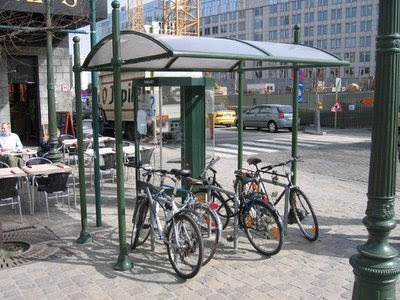
In some lands they even protect from the elements. (I know, we don't even do that for people!)

Car spaces can be converted into bike parking with great success and look at the capacity !

Great racks in great locations are good for cyclists and good for the neighborhood and good for business!
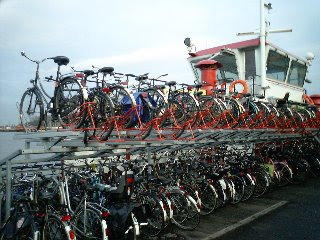
Bike parking can also be innovative and opportunistic, such as this out of commission boat that uses the sliding racks like the ones that have been sitting unused at Hollywood & Western for a couple of years.

These bike racks have been kept under lock and key where they're safe, since 2005. Not one has been stolen.

These are some of the loneliest bike racks in the city of Los Angeles. The next closest racks are a mile to the west and a quarter mile to the east.

When in doubt, add some more racks.

Why can't we get along?

Apparently we can!

For the nature lover in all of us!


While the City of Los Angeles is full of examples such as these of weak and ineffective attempts to provide bike parking, the City Council went to work and put into place an ordinance specifying the City's bike parking standards. All that's required is the political will to implement this legislation.

From the Los Angeles Municipal Code: (LAMC 12.21-A. 16)

16. Bicycle Parking and Shower Facilities. (Added by Ord. No. 167,409, Eff. 12/19/91.) Off-street parking spaces for bicycles and facilities for employee showers and lockers shall be provided as follows:

(a) In the C and M zones, for any building, portion thereof or addition thereto used for non-residential purposes which contains a floor area in excess of 10,000 square feet, bicycle parking spaces shall be provided at the rate of two percent of the number of automobile parking spaces required by this section for such non-residential uses; provided, however, that at least one bicycle parking space shall be provided for any such building having a floor area in excess of 10,000 square feet of non-residential use. If the calculation of the number of required spaces under this paragraph results in a number including a fraction, the next highest whole number shall be the number of spaces required.

(b) The bicycle parking space requirements in Paragraph (a) shall also apply to any building, regardless of zone, owned by the City of Los Angeles and used by the City for government purposes which contains a floor area in excess of 10,000 square feet.

(c) All bicycle parking spaces required by this Subdivision shall include a stationary parking device which adequately supports the bicycle. In addition, at least half of the bicycle parking spaces shall include a stationary parking device which securely locks the bicycle without the use of a user-supplied cable or chain. Devices which hold the bicycle upright by wheel contact must hold at least 180 degrees of wheel arc.

(d) Each bicycle parking space shall be a minimum of two feet in width and six feet in length and shall have a minimum of six feet of overhead clearance.

(e) Bicycle parking spaces shall be located no farther than the distance from a main entrance of the building to the nearest off-street automobile parking space.

(f) Bicycle parking spaces shall be separated from automobile parking spaces or aisles by a wall, fence, or curb or by at least five feet of open space marked to prohibit parking.

(g) Aisles providing access to bicycle parking spaces shall be at least five feet in width.

(h) Signage which is clearly legible upon approach to every automobile entrance to the parking facility shall be displayed indicating the availability and location of bicycle parking.

(i) Showers and lockers shall be provided as required by Section 91.6307 of this Code. (Amended by Ord. No. 177,103, Eff. 12/18/05.)

It was up to the LADOT Bikeways Division to develop the standards for bike parking and they did not disappoint!
While cities such as Chicago fumble along with commitments and results, Los Angeles demonstrates its unique approach to supporting the cycling community by putting pen to paper towel and drafting some almost accurate plans for bike parking installation, closing any back doors and putting to rest any insinuations that the LADOT is insincere in its support of cycling as a valid means of transportation.

(The paper towel is actually the bike rack plan offered by LADOT Bikeways to facilitate the installation of the bike racks at the Griffith Observatory. It's hard to imagine how it resulted in the re-installation and then the re-re-installation of the racks. It looks so simple, complete with the minor error included!)

Let there be no doubt. The evidence is in! The LADOT Bikeways Division is committed to supporting the cycling community!

CityWatchLA - Season Opens at the Orange Line Campgrounds

Zach Behrens wrote of the Orange Line Bikeway on LAist and keyed in on the homelessness issue and the encampments. Dana Bartholomew of the Daily News then wrote of the Bikeway and the blight and contrasted it with the Metro's commitment to bike facilities at the stations. CityWatchLA then ran this piece focusing on the lack of maintenance, security and oversight along with the engineered isolation and unfortunate landscaping choices that work together to create an unsafe environment.

CityWatch, Feb 3, 2009
Vol 7 Issue 10

Orange Line Bike Path a Bumpy Ride
By Stephen Box

The Orange Line … an express bus service that runs across the south Valley … is a classic example of the axiom "Success has many parents but failure is an orphan."

When it comes to ridership, LA County Supervisor Zev Yaroslavsky, Metro CEO Roger Snoble and LA City Council Transportation Chair Wendy Greuel all speak glowingly of the popularity of the Orange Line and point at the near capacity numbers as evidence of their wisdom.

When it comes to the bikeway that runs alongside the Metro Orange Line, all of a sudden the crickets chirp and there's nobody left at the podium taking credit or responsibility for the maintenance issues, the homeless encampments, the graffiti, the crime, and the general decline of the bikeway.

Calls to the Metro are forwarded to the Sheriff's Department with an explanation that the Sheriff has a contract to provide security and law enforcement for the Orange Line. Calls to the Sheriff's Department yield an explanation that their contract is for the transitway, not the bikeway and that it’s an LAPD problem. Calls to the LAPD yield a series of referrals to the gang detail, the homelessness detail, the bike patrol and the Senior Lead Officers, all of whom seem to be missing in action, based on recent experience.

At the end of the day, it turns out that the LADOT has a Bikeways Division that has a contract with a contractor who is then responsible for the maintenance of the Orange Line bikeway, 14 miles of bike path, separated in many areas with a sound wall on one side and a chain link fence on the other, heavily landscaped, overgrown and littered with campsites.

The Orange Line opened in 2005 with a celebration that included a bike ride for supporters. Bike Activists reveled in the attention but grimaced at some of the engineering and design choices that indicated a lack of empathy for the cycling population and a sensitivity to the basic needs of a cyclist.

Cyclists compiled a report of the bikeway and provided recommendations on the intersection conflict points, the lack of cyclist oriented signalization, the poor landscaping choices and the isolation that results from putting up chain link fence and sound walls on either side of the path.

The Orange Line Bikeway was developed in conjunction with the LADOT Bikeways division and somewhere along the way the responsibility for the Orange Line Bikeway shifted from the Metro to the City of Los Angeles.

The City of LA took over like a proud parent, producing a PowerPoint show entitled "Orange Line Bike Path: Integrating a Bikeway within a Bus Rapid Transit Corridor" that they take on the road to transportation conferences.

The unfortunate reality is simple. The Orange Line Bike Path is no-man's land. It is isolated. The entrances are littered with shopping carts. The abundant trash and the overgrown landscaping give witness to the lack of supervision. The paths worn through the bushes bear indicate heavy off-path foot traffic.

This past Saturday, Nate Kapin of Sherman Oaks interrupted his Orange Line bike ride to comment. He says he's a regular, having lived in the Valley since May of 1940 "when you could hunt rabbits here." He says he's seen it all and that he rides the Orange Line every day. "This could be a real park. Put in some benches so people could sit and socialize, clear some of the brush back, put in a water fountain, some bathrooms, people would flock to this path. But not now! Look at it! It's trashed! I see people in the bushes, I see it all!"

It's too late to redesign the Orange Line bike path, but it's not too late to hold the contractor responsible for fulfilling his obligations for maintenance. It's not too late to get the Sheriff's Department and the LAPD to agree on who has jurisdiction and to get law enforcement to patrol the bike path. It's not too late to get the LADOT Bikeways Division to put the PowerPoint aside and to spend some time on the Orange Line bikeway.

Perhaps it's even time for a Bike Ride. After all, the Sheriff's Department has a bike patrol team. The LAPD has a bike patrol team. The Park Rangers even have a bike patrol team and by the overgrown look of things, perhaps they're the ones we should start calling


(Stephen Box is a transportation and cyclist advocate and writes for CityWatch. He can be reached at Stephen@ThirdEyeCreative.net)


Thursday, January 29, 2009

LADOT Bikeways "Under New Management"

On Tuesday, February 3, 2009, "Storm the Bastille" will celebrate its 2nd anniversary of bike rides to the City's Bicycle Advisory Committee, all the while banging the drum and fighting for an open and inclusive process for bike advocacy and fighting for the reorganization of the long dormant and ineffective BAC.

It was a long and arduous journey but along the way the City Council responded to the clamor. The Transportation Committee and the Planning and Land Use Committee intervened, resulting in an action that reorganized the BAC and directed departments from Planning to Rec & Parks to Public Works to the City Attorney's office to assign and direct staff to support the efforts of the "new" BAC.

Along the way, Paul Meshkin was named as the new head of the LADOT Bikeways Engineering Group. Paul is returning to Bikeway's and to this position and we are optimistic that the City Council directed reorganization and his leadership will result in a successful LABAC.

Attached is a copy of a letter I submitted to Paul this week.

*************************************************************************

Paul,

Congratulations on your tour of duty as the head of the LADOT Bikeways Engineering Group. I hope you are successful in revitalizing the department and I look forward to working with you.

As for the opportunity ahead:

1) The City of Los Angeles has an early notification system in place so that members of the community can simply sign up and then receive an email with the agendas of the City Council, the Council Committees, the Commissions etc. I realize that the LA Bicycle Advisory Committee has a long tradition of using the US Postal Service in order to deliver little packets of printed matter including agendas and clippings but those days are so long gone. We have a new president, he twitters and the time has come for the City of Los Angeles and the BAC to join the revolution.

Please, take advantage of the technology and let's start communicating effectively and let's truly engage the public in the business of the Los Angeles Bicycle Advisory Committee.

2) The City of Los Angeles has property throughout the City. There is no reason to continue to use the cold and inhospitable Parker Center auditorium unless your real objective is to alienate the public in an environment that is best suited for catching pneumonia. The simple standard for a meeting place is that it is accessible on foot, by bike and by mass transit. There are many facilities that fit the bill and we have had the conversation before. If the location choice is made based on what suits the staff of the LADOT best, then you are simply demonstrating that the BAC belongs to the LADOT and not the people of Los Angeles, a charge that has been leveled in the past.

Please, pick a new location for the LABAC meetings. While you're at it, get the committee meetings out of the LADOT offices and hold them in the evenings when the public might actually attend them. Put the public first and watch the BAC actually become an effective advisory body.

3) The City of Los Angeles has a Bikeways department but the LABAC seems confused as to where bikeways facilities come from and how they appear. Perhaps now would be a good time for the Bikeways department to clarify its role, its function, its responsibilities in the grand scheme of things. Many on the BAC are surprised to discover that the Bicycle Plan is a Planning document, part of the Transportation Element, a part of the General Plan. hence the need to keep Planning involved in the BAC business or visa versa.

Please, clarify once and for all the many departments who have a piece of the streets and let the BAC know who does what and how it all works, or in many cases, doesn't work.

4) The City of Los Angeles is a big place with 6500 miles of streets. It would be great to have an idea of where we stand with regards to bikeways amenities and infrastructure. Especially since we are the advocates who are urging our elected officials, from local to federal, to support our communities in the development of robust transportation projects that truly revitalize and stimulate our communities. Yet we don't even know where we stand with regards to bikeways status, let alone performance and goals.

Please, give us an inventory of the City's bikeways assets and a report on the progress that was made last year along with the goals of this upcoming year. It would seem that this would be the most basic of information, especially if we are to work together to change the world. "Where are we, what's going on and where are we going?"

5) The City of Los Angeles has almost 90 Neighborhood Councils, all of whom are filled with volunteers who operate under that same basic Brown Act, Conflict of Interest, Ethics standards as our City Council and Commissions. Somehow the NC's are able to function with some degree of success under these rules and regulations while the LABAC seems to flounder. The last meeting had the Brown Act getting abused while the Committee argued over how to make a motion.

Please, bring in the City Attorney as the City Council has recommended, train the BAC in the Brown Act and then get serious about putting the debate over process to rest and let's get busy changing the world.

6) The City of Los Angeles, in its infinite wisdom, created the Bicycle Advisory Committee in 1973. Along the way, a Charter was adopted and it refers to an expectation that BAC members "regularly communicate in writing with their respective council member and staff as well as the Mayor's Office and staff." Copies of this correspondence was to be forwarded to the Bikeways Section of the LADOT.

Please, make the BAC member reports for 2008 available as soon as possible. This goes a long way to determining where we are so that we can agree on where we want to go. In light of the upcoming agendized elections, it would seem that this small performance standard would also be of relevance as we evaluate candidates for Chair and Vice-Chair.

7) The BAC is an advisory body yet the bulk of the committee's activity seems to be listening to reports. The cycling community is regularly directed to the BAC by departments including the LAPD, the City Council, the Planning Department and the City Attorney when issues related to cycling in the city come up. To that end, it is imperative that the BAC get in the business of representing and of offering advice to the City of Los Angeles. In order to accomplish that, topics must come before the BAC before they are history. Everything from the Bicycle Plan workshops to the reorganization of the BAC seemed to take the BAC by surprise this past year.

Please, put the agenda in the hands of the committee so that the public can get items on the agenda in a timely fashion. Whatever the process is, it must be open and transparent and it must be clearly articulated. The agenda is not a secret document developed behind closed doors. Items on the agenda must be for discussion and for action if the BAC is to truly become effective.

8) The City of Los Angeles is in the midst of updating the Bicycle Plan, a process that was to include two workshops that seemed to have fallen off the landscape. In fact, the entire plan seems to have disappeared off the radar. The civic engagement element is one of the most important elements of the process and the cycling community has been quite vocal about the poor outreach in the first four workshops. Under "NEW!" the LA bike plan website offers a summary of public input from April of '08. That's not really news and it's not really new.

Please, communicate loudly and clearly the status of the Bicycle Plan and ensure that the outreach to the public will be more effective and inclusive than the first four sessions and the second two sessions that disappeared.

9) Streets are currently being resurfaced and striped. Western, Hollywood, Vermont, Edgemont are just some of those in Hollywood that have recently received a facelift. We're told that this is the best time for bikeways striping and yet...no bikeways improvements. Are the different departments talking to each other? Are the plans for bikeways improvements on hold? Are the priorities for the different departments our of sync? What happened to the promise of Sharrows?

Please, reveal the immediate plans for the Sharrows in Hollywood and let's work together to make them happen.

The upcoming "Storm the Bastille" ride on Tuesday, February 3, 2009 will be our two year anniversary! We've been riding to the LABAC meetings and banging the drum, all the while hoping that the BAC would become an open and inclusive and effective body, committed to supporting cyclists and improving the quality of life in Los Angeles.

I look forward to working with you to make this happen.


Stephen Box
323-962-6540
http://twitter.com/SoapBoxLA
http://profile.to/stephenbox/
http://www.linkedin.com/in/stephenbox
http://BikeWritersCollective.com
http://SoapBoxLA.blogspot.com
http://illuminateLA.com


Tuesday, January 27, 2009

CityWatchLA - DOT GM Robinson: “Time for Great Opportunity”

CityWatch, Jan 27, 2009
Vol 7 Issue 8

The Department of Neighborhood Empowerment convened the first of three NC Town Halls this past Saturday, drawing approximately 50 community leaders to the Valley Civic Center for a session that was heavy on speakers but light on content.

Rita Robinson, GM of the Department of Transportation, was the headliner and her casual style drew positive comments from the audience. Dismissing pessimists and optimists alike, Robinson urged the community to partner with her as realists saying "We are a city in crisis, we are a nation in crisis, but it's also a time of great opportunity. Our challenge is figuring a way to work together to put our money to the best use possible."

Robinson opened the room up for public comment and literally the entire room rose, causing traffic jams at both microphones. NC reps immediately went local, very local, addressing specifics to their neighborhoods that demonstrated the huge chasm between City Hall's high-altitude bombing approach to transportation and the reality on the streets.

A pastor of local church spoke of a 20% reduction in attendance as a result of the recent adjustment in parking policies in his neighborhood, eliciting from Robinson, "I'm all in favor of folks going to church, Heaven knows we need the prayer!" She promised to look into the local issue of street parking as well as the many other red curb, left-turn, debris-in-the-street, misplaced-transit-stops local issues that help the focus of the attending representatives.

There were a couple of speakers who went a bit more global, such as August Steurer, PLUM Chair from Woodland Hills Warner Center, who pointed out that as the community works so hard to address land use issues, it's tough to advise on Planning and Development if the local community doesn't know what's going on with Transportation. He urged the department to join with Planning in early notification of local work and projects so that they can be integrated.

The event was initially billed as a Neighborhood Council "Valley Training Day" but somewhere along the line, it shifted into a Town Hall meeting.

Councilmembers Richard Alarcon, Wendy Greuel and Dennis Zine opened the session, all professing their love for Neighborhood Councils and all managing to lay down a foundation of "budget crisis" along with a dose of "lower your expectations, 'cause we're out of money."

Councilman Alarcon spoke of the Council File Motion and expressed his commitment to working with Neighborhood Councils to make sure that it became a viable mechanism for NC involvement in City Government. Councilwoman Greuel informed the attendees that Angelinos spend an average of 93 hours a year in traffic, forgetting that this same crowd probably spends an average of 94 hours a year listening to reports on traffic, all while waiting for a couple of minutes at the microphone. Councilman Zine spoke of his world travels, admonishing the crowd to lower their expectations. "I've traveled all over the world and, in comparison, it's not so bad here!"

Commissioner Al Abrams, Isaias Cantu of the City Clerk's office and Vivian Swanigan of the City Attorney's office all took a turn at the carefully choreographed and well-timed session, complete with "Wrap it Up" cue cards and featuring Gong-Show enforcement, delivering what could be best described as a living bulletin full of announcements.

BongHwan Kim, GM of the Department of Neighborhood Empowerment, speaking under the same stopwatch pressure as the others, explained that the heads of departments throughout the City have complained "We just don't know how to relate to Neighborhood Councils. We have a lot of information that we need to communicate but we don't know how." (Stephen Box is a transportation and cyclist advocate and writes for CityWatch. He can be reached at Stephen@ThirdEyeCretive.net)

Friday, January 23, 2009

CityWatchLA - LALive: Third World Comforts

CityWatch, Jan 23, 2009
Vol 7 Issue 7

LALive, the new entertainment complex across from the Staples Center, has within it the potential to become a vital public place worthy of a Great City, if only they would add plumbing along with a commitment to serving the public who arrive on foot, on bicycles and via mass transit.

This past Tuesday, Councilwoman Jan Perry hosted "LA's Biggest Inaugural Viewing Party" at LALive's Nokia Plaza, an event that drew an estimated 1,500 people, some of whom arrived in the wee hours of the morning in order to stake out the prime spots. In spite of the fact that LALive is designed to handle crowds of up to 30,000 people, this simple Inaugural Party crowd of 1,500 required the placement of porta-potties on Chick Hearn Court, all because there are no public facilities at LA's most acclaimed of public facilities. 

LALive's Managing Director, Lisa Herzlich, contradicts the claim that there are no bathrooms by pointing out that there are restrooms in the West Garage, located a block west of LALive, on the other side of the Nokia Theatre. "It actually makes sense, if you think about it, because after driving for 45 minutes to get here, our patrons appreciate having a convenient restroom." This is a good point and in all fairness it appears that LALive does actually have restrooms, although the need for porta-potties for a simple crowd of 5% capacity demonstrates that the restrooms are of questionable location and efficacy.

Herzlich's response brings up a larger issue: LALive's demonstrated bias to those who arrive in private vehicles over the transportation solutions who arrive on foot, by bike and via mass transit.

Perry's invitation to the Inaugural Party reinforces this bias by including the lure of "Complimentary Parking at Olympic West Garage," an odd perk that was publicized in the Downtown News, a publication that caters to a downtown audience who would surely be sensitive to the impending "pedestrian-oriented" direction that this neighborhood is headed.

LALive's tenants, in the same issue of the Downtown News, demonstrate the same tired mobility paradigm with their LALive "Lunch just got a lot more interesting..." ad that features "Parking Validation with purchase" as the big draw.

An inspired invitation to LALive's Inaugural Party would have included mass transit directions, bike parking directions, a call to take to the streets and walk this great city. Inspired advertisements would have offered discounts to those who have a Metro ticket, to those who ride a bike, to those who are part of the streetlife revolution!

But instead, the LADOT and the LALive staff were busy directing vehicular traffic to their VIP facilities in the West Garage while the Conga Room staff claimed that they didn't have restrooms, the ESPN staff informed the public that the restrooms were for customers only, the very polite LALive staff directed cyclists down the escalators into the bowels of the parking facility in order to lock up their bikes, and the public enjoyed toilets worthy of a construction site. Something's wrong with this picture!

LALive is a work in progress, apparently operating under a Temporary Certificate of Occupancy. To that end, James Laite, Senior Director of Engineering, acknowledges that there are still discussions taking place with regards to amenities including restrooms and bike racks and way-finding that would enable visitors to actually find the facilities without having to use a GPS. "LALive was designed by one group while another group manages it, which creates an interesting challenge for us as we encounter situations such as the lack of restrooms and the bike parking facilities."

Cyclists have complained that the bike parking, specified in the City's Municipal Code as being at a minimum of 2% of automobile parking capacity, is inaccessible in its current location in the underground parking facility and that it falls short of the legal minimum. Cyclists also point out that half of the bike racks are those referred to as "Marquis de Sade" racks and are cumbersome to the point of absurdity, sitting empty in confirmation of their uselessness.

Meanwhile, proponents of streetside bike parking point out that the impact of bike racks on the sidewalk is both psychological and practical. The presence of visible bike racks confirms that cyclists are welcome, provides an intuitive opportunity to park and keeps the bikes safe and in the public eye. The need for intuitive bike parking locations was demonstrated this past Tuesday as bikes were locked to the trees and poles that ring the LALive facility, all while the underground racks sat empty.

John Fisher, Assistant General Manager of the City's Department of transportation, points out that the City Council has given LALive a unique permit which will allow for the closure of Chick Hearn Court on a regular basis, creating a pedestrian street. "We're working with LALive to implement an automated bollard system that would allow them to close the street between the Staples Center and the LALive complex without having to deploy significant manpower." This "regular" street closure is projected to start at 7pm on Friday evening and continue through the weekend until 4am on Monday morning.

LALive 's 1st class automated bollards complemented by 3rd world porta-potties are all part of the interesting tug-of-war that is taking place as Los Angeles grapples with the design standards of the past and proposed innovations of a pedestrian oriented urban design standard of the future. (Stephen Box is a transportation and cyclist advocate and writes for CityWatch. He can be reached at Stephen@thirdeyecreative.net )

Thursday, January 22, 2009

Memorializing Fallen Pedestrians

Damien Newton from StreetsblogLA writes of a group in Portugal who install pedestrian crosswalks made up of the names of those pedestrians who have died crossing the street. The artistically designed memorials include the tag, "1/4 of car accident victims are pedestrians."

Here is Los Angeles, we also have a mechanism for memorializing those who have died in an attempt to simply cross the street. While not quite so dramatic as the ZebraStripe crossings in Portugal, the Los Angeles memorials serve as a constant reminder that our streets are dangerous and that crossing them is risky business.

Los Angeles names buildings and freeways after civic leaders and local heroes but crosswalks are reserved for the children who die trying to cross the street. Hardly the mark of a Great City.

The "Demariya Grant Memorial Crosswalk," on Rodeo Road between Rodeo Lane and Farmdale Avenue near Dorsey High School, was dedicated in memory of nine year old Demariya Grant who was struck down and killed by a hit and run driver in December 2005. The "Jason Quarker Memorial Crosswalk" at 6th and Jefferson honors Jason Quarker, who was struck and killed while crossing Jefferson on his way to the 6th Avenue Elementary School.

Meanwhile, LAist draws attention to the machinations of the Los Angeles Department of Transportation as they contemplate the removal of the crosswalk at the corner of Magnolia and Blakeslee. The crosswalk falls halfway between Lankershim Blvd. and Vineland Ave.

The Intersection has significant housing on the north side of Magnolia and on the other side of the street are abundant amenities ranging from local theatres to restaurants to shops to a local church which meets in one of the theatres. It would seem that the intersection of Blakeslee would be an ideal location for a crosswalk but the LADOT has posted signs indicating that "the marked crosswalk at this location is proposed to be removed as part of a traffic safety improvement."

A call to the posted number at the LADOT yielded an explanation for the proposed crosswalk removal consisting of "The crosswalk is being reviewed in order to determine if it meets the state and federal guidelines."

Hmmm! "Traffic Safety Improvements" and "State & Federal guidelines" sound like worthy motivations until you factor in the proposed action: they're proposing to remove a crosswalk!

John Fisher, Assistant General Manager of the LADOT explained that they did a study a several years ago and they reviewed 7 years of data, determining that the removal of crosswalks resulted in a 61% reduction in pedestrian collisions. As a result, the department routinely looks at the crosswalks in Los Angeles and evaluates them for removal. Fisher adds, "Of course, if this location is an activity center, then this would be taken into consideration as we evaluate the crosswalk, the flow of traffic and the volume, the pedestrian activity and the community response."

(When Fisher was asked if the reduction of ped collisions might be due to a reduction in pedestrians, he acknowledged that it might be an explanation but was not part of the study)

This particular street was recently featured in the LATimes in an article that detailed the community's response to the increase in parking meter rates along with the extended hours of operation. Critics charge that the LADOT acted without public input or notification and that effect on the community was negative. Now this?

Nancy Bianconi of the NoHo Arts District was shocked to find out that the LADOT was considering the removal of the crosswalk, exclaiming "If anything we need a smart crosswalk, one complemented by lights and traffic calming that supports the vibrant streetlife that we are working to create in the NoHo Arts District."

Linda Fulton, owner of the Avery Schreiber Theatre, points out that the city has made a lot of money off that crosswalk, writing tickets to motorists who don't yield to the pedestrians. "There are 7 theatres between Lankershim and Magnolia, there is lots of mixed-use development on Magnolia, all drawing pedestrians to this community, and we need to support the pedestrians, not abandon them in favor of improving the flow of traffic."


On the south side of Magnolia there are shops, 7 theatres, restaurants and other attractive signs of streetlife. It seems like the least the LADOT could do is to support those who simply want to cross the street.

This is the sign the LADOT posted on both sides of Magnolia, soliciting comments on a process that isn't explained. A phone call to the number is answered by a woman who says "I can't answer questions, I only take down comments."